Design Tools
ClimaScapes is built up with a scientific research approach which aims to contribute to actual and urgent design practices. For this reason, we have developed a corpus of case studies, which we have explored and critically analysed.
Throughout the process we asked ourselves “how can Climate and Nature be now part of the architectural design process? And why do we need this to happen?”
ClimaScapes is a design tool which aims to provide good examples of streetscapes' regeneration through climate-adaptive and nature-based solution, around the world. By doing so, we have selected our case studies, not only based on the presence of green and blue solutions, but rather on their spatial and social quality.
As architects, urbanists, and designers we are aware that every spatial transformation has an impact on people's lives, habits, behaviours and health. For this reason, we not only want to understand and explain the environmental, social, climate and economical benefits of using nature-based Solution, but we especially want to explore their spatial impact as spatial devices which are able to promote transformative actions.
By confronting the case studies and the relevant literature of these sectors through a Research about Design approach (see Methodology), we developed three design tools that support us in defining these aspects:
- Parameter Wheel, which shows the key themes into eight main categories;
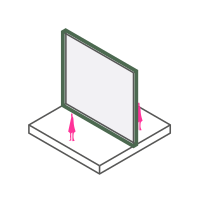
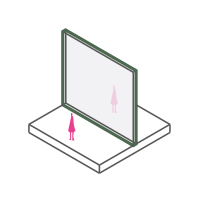
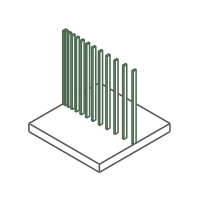
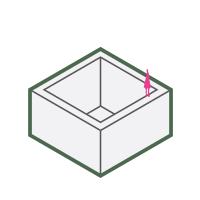
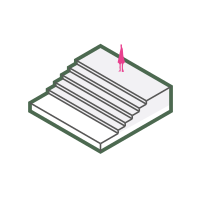
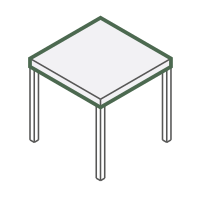
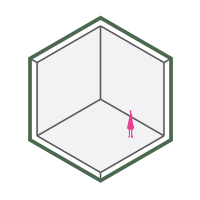
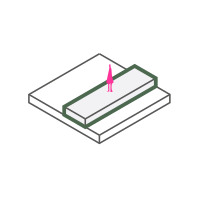
- Abacus of Spatial Devices and Transformative Actions, which describe the urban spatial transformation through the spatial impact of NbSs;
- Invariant Architectural Characters Wheel, which highlight the invariant elements of the projects.
These tools are intended as dynamic instruments for future design practices, rather than static matrices, as they support the de-composition and re-composition of streetscape projects through a design-oriented, interdisciplinary lens.
These tools have been applied to the case studies displayed in this website and can be adapted for design proposal and developments.
Parameter Wheel
Eight thematic parameters and forty-two sub-parameters for evaluating project ambitions and performance.
Abacus of Spatial Devices and Transformative Actions
Design-oriented spatial reading of NbS elements through geometrical elements, spatial devices, and transformative actions.
Invariant Architectural Characters Wheel
Four categories of architectural invariants: Trans-disciplinarity, Inter-scalarity, Multi-temporality, and Multi-subject.
Do you want to know?
Check in our published works about the methodology of the research! Furthermore, a paper discussing the whole process is coming soon. Stay tuned for more news!
If you want more info, you can also contact us at: ina.macaione@unibas.it; bianca.andaloro@unibas.it; alessandr.raffa@unibas.it